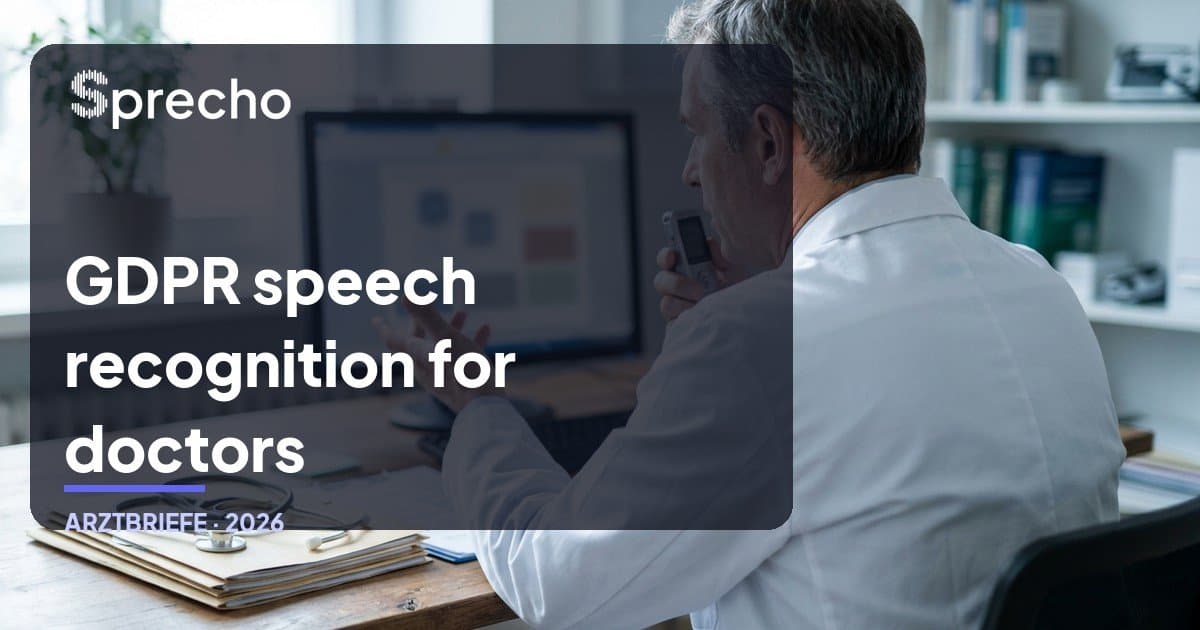
Dictating doctor's letters (Arztbriefe) saves physicians real time, but it also involves patient voice recordings and medical content that fall under GDPR Art. 9 as special-category data and are protected by professional secrecy under § 203 StGB. This guide explains how GDPR-compliant speech recognition helps doctors dictate letters, findings and reports without exposing patient data, and why the fading Dragon Medical leaves many practices looking for a maintained EU alternative.

Why dictation matters for doctors
- Speaking is faster than typing: Arztbriefe, findings, discharge summaries and referral letters can usually be dictated in far less time than they can be typed manually, which reduces documentation backlog in busy practices and clinics.
- Less screen time: When doctors can speak naturally instead of constantly switching to the keyboard, more attention stays with the patient and less time is lost to after-hours admin.
- Cleaner documents: AI formatting can turn spoken notes into punctuated, structured text so the result is closer to a finished document instead of a rough transcript that still needs heavy editing.
- Works where doctors write: The practical benefit only appears if dictation works directly in Word, Outlook and the practice or clinic information system rather than forcing staff into a separate transcription workflow.
The compliance problem: health data and § 203
- Special-category data: A dictated medical letter can include diagnoses, medications, symptoms and treatment history. That makes the content health data under GDPR Art. 9, while voice can also qualify as biometric data depending on the processing context.
- Professional secrecy: Physicians in Germany are bound by professional secrecy under § 203 StGB. If patient dictation is sent to a processor that is not handled appropriately from a legal and contractual perspective, that can create serious confidentiality risk.
- US cloud risk: A US cloud tool remains problematic even if it advertises EU servers, because the US CLOUD Act of 2018 can require a US company to hand over data regardless of where that data is stored.
- Safer setup: The safer path for medical dictation is an EU provider with EU hosting, clear processor terms and a Data Processing Agreement. For healthcare teams evaluating options, our healthcare speech recognition solution shows what that setup looks like in practice.
| Requirement for medical dictation | Why it matters |
|---|---|
| EU company + EU hosting | Keeps health data out of US legal reach (CLOUD Act) |
| Data Processing Agreement (DPA) | Required to process patient data lawfully |
| § 203-suitable handling | Protects professional secrecy |
| Works in the practice system | Fits the real clinical workflow |
Dragon Medical is fading: what doctors need now
- Legacy leader, weaker outlook: Dragon long dominated medical dictation, but the desktop line has clearly lost momentum. Dragon Professional is still known, yet the consumer line was discontinued and desktop development has stalled since Microsoft acquired Nuance in 2022.
- Need for a maintained successor: Doctors increasingly need a modern, maintained and GDPR-conscious alternative that works across current workflows. If you want the side-by-side view, compare Sprecho and Dragon for the practical differences.
| Capability | Sprecho | Dragon (Medical/Professional) |
|---|---|---|
| Actively developed in 2026 | Yes | Stalled since Microsoft acquired Nuance (2022) |
| EU company + EU hosting | Yes | No |
| Cross-platform (Windows + macOS) | Yes | Windows-focused |
| 100+ languages | Yes | Partial |
| Pricing | €10.92/mo net per seat | ~€699 one-time / enterprise cloud |
 Dragon
- Medical vocabulary heritage: Dragon is still associated with strong medical vocabularies and a long history in physician dictation.
- Windows-centric setup: For many teams, the downside is that it remains Windows-focused rather than truly cross-platform for modern mixed-device environments.
- Price and momentum: At around €699 one-time for Dragon Professional, it is a much larger upfront purchase than Sprecho Pro at €10.92 per seat/month net plus 19% VAT, and it no longer shows the pace of active desktop development many buyers want in 2026.
- Migration path: Practices considering a switch can review the Sprecho vs Dragon comparison before replacing older dictation workflows.
How Sprecho works for medical practices

- EU end-to-end: Sprecho is a GDPR-compliant product by Melo Designer GmbH in Germany. The app, database and storage run in Germany on STRATO, while GPU transcription and LLM inference run with Media Trooper in Germany and the Netherlands, so health data stays within the EU.
- § 203-suitable handling: With a Data Processing Agreement in place, the professional-secrecy chain can remain intact for medical practices that need a processor setup suitable for confidential patient communication.
- Dictation in real workflows: Doctors can dictate directly into Word, Outlook and the practice system instead of copying text between tools. That matters for Arztbriefe, findings, emails, referrals and internal notes.
- 100+ languages and AI formatting: Sprecho supports more than 100 languages and can turn raw speech into more structured text, which helps when practices work with multilingual staff or international patients.
- Cross-platform and easy to test: It works on Windows and macOS and can be tested with a 14-day free trial without a credit card. Current business pricing starts at €10.92 per seat/month net plus 19% VAT, or €9.24 per seat/month net billed yearly (€110.82/year) plus 19% VAT.
Scenarios: GP, specialist, clinic
GP practice
- Between-patient documentation: GPs can dictate referral letters, visit notes and follow-up instructions between appointments instead of stacking paperwork for the evening.
- Automatic structure: Formatting support helps turn spoken notes into readable, usable text more quickly, which is especially valuable in high-volume primary care. For this use case, see Sprecho for healthcare teams.
Specialist
- Detailed findings: Specialists often need longer, terminology-heavy documentation. Dictation makes it easier to capture nuanced findings and Arztbriefe while the case is still fresh.
- Consistency: Structured output helps maintain a more consistent style across findings, reports and communications with referring physicians. More details are available on our healthcare solution page.
Clinic / MVZ
- Team rollout: Larger clinics and MVZs need more than individual convenience. They need central billing, admin controls and processor documentation that fits procurement and compliance review.
- Enterprise controls: Sprecho Enterprise costs €21.84 per seat/month net plus 19% VAT, or €18.47 per seat/month net billed yearly (€221.64/year) plus 19% VAT, and adds SSO/SAML, MDM, audit-log export, dedicated support and invoice billing. You can review pricing for practices and clinics to plan a rollout.
Conclusion
- Time savings with legal guardrails: Dictation gives doctors time back, but medical documentation is not ordinary text. It requires EU jurisdiction, GDPR-aware processing and handling suitable for § 203 StGB confidentiality.
- Practical fit for healthcare: Sprecho keeps Arztbriefe dictation in the EU, works where doctors already write, and is actively maintained for modern medical workflows.
- Try it now: Start your 14-day free trial with no card and dictate your next Arztbrief compliantly with Sprecho pricing and plans.